Guide
Sizing Charts, Explained: EU, UK, US and Why They Disagree
By Rowan Hale, Footwear Editor · Published Oct 6, 2026 · Updated Oct 6, 2026
The three sizing systems disagree because they were built from different raw measurements on different bases — and none of them measures your foot. No chart converts them perfectly, because the inputs themselves are approximations. Once you see what each system actually counts, the confusion mostly dissolves and cross-border buying becomes a routine instead of a gamble.
Different units, different starting points
UK sizing grew out of the barleycorn, a unit of one-third inch, counted along the shoe last. US sizing borrowed the barleycorn but set its own zero point, which is why a US men’s size typically runs one above its UK equivalent — women’s offsets drift further still. EU sizing uses the Paris point, two-thirds of a centimeter, and here is the catch: it counts length along the last, the mold the shoe is built on, not the foot inside it. Every manufacturer pads that last differently for toe room and thickness, so two EU 42s from different houses can differ by more than the gap between whole sizes.
The half-size gap
US and UK charts run in half steps; most EU charts do not. A foot that falls between EU whole numbers gets rounded, and the rounding error — up to four millimeters at the edges — is exactly the toe-room margin that decides whether a long walking day ends comfortably. Some European brands now publish 42.5 and 43.5 on their own initiative, which is the market quietly admitting the coarser scale was losing customers.
Brand drift is the quiet variable
Lasts are proprietary geometry. A size 42 from one house fits like a 42.5 or 43 from another, and width adds a second axis that most charts ignore entirely. Retailer listings and owner reviews fill up with “runs small” and “runs long” notes for precisely this reason: the letter on the box is a starting point, not a fact. The published chart is one data point; the last is the truth it approximates — and a new version of the same shoe can drift from the old one when the last gets recut.
A checking routine that survives borders
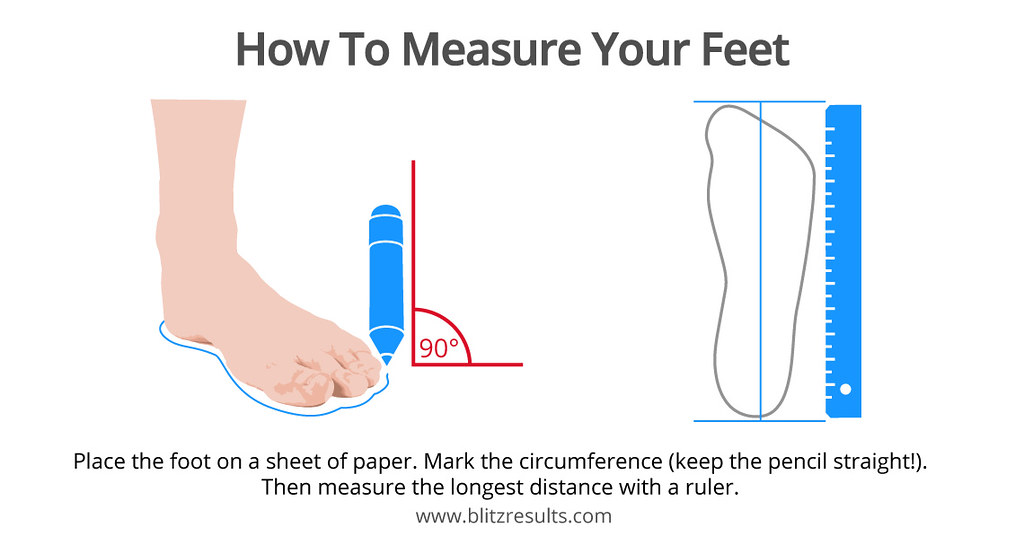
- Measure both feet in centimeters, standing, at the end of the day — length plus width, since the larger foot sets the size.
- Find the chart the manufacturer publishes for that model, not a generic conversion table; charts differ by brand and sometimes by line.
- Convert through centimeters, never through country letters — chaining US 9 to EU 42 stacks two approximations, while centimeters stack one.
- Check width separately, because most charts are length-only and width is where wide or narrow feet actually suffer.
- Buy where returns are painless, and treat the first indoor walk as part of the fitting.
None of this makes the systems reconcilable, because they measure different things with different allowances. It makes them predictable. Treat the three letter codes as dialects of one language rather than translations, route every conversion through centimeters, and let the last overrule the letter whenever evidence appears. Our broader sizing guide extends this to width and arch fit, and the sizing mistake that ruins weekend trips is the predictable result of skipping step five.
FAQ
- What is a US 9 in EU and UK sizes?
- As a rough anchor, US men's 9 maps to UK 8 and around EU 42 — but treat that as a starting point, never an answer. The offsets between systems shift by brand because each manufacturer builds on its own last, so centimeters of foot length are the only conversion worth trusting.
- Why do EU sizes have no half sizes?
- The EU scale runs in two-thirds-centimeter steps and most charts stop there, while US and UK scales add half steps of roughly four millimeters. Some European brands now publish 42.5 and 43.5 themselves, which tells you the rounding gap was wide enough to matter to customers.
- Should I size up when buying shoes abroad?
- Not automatically. Size up only when the centimeter math, the brand's chart for that specific model, and your width all point the same direction. Blanket half-size-up rules exist because people skip those checks, and they fail just as often as they work.
On the Ground
Four surfaces, read separately
Airport day
Terminal floors, security lines, overnight feet.
Beach town
Hot pavers, algae-slick steps, sand in everything.
City walking
Old stone that never flexes underfoot.
Trail day
Day-trip dirt that turns to mud by noon.